LCL sea freight from Malaysia — ship by the pallet, not by the container

Most cargo does not fill a container, and waiting until it does is not a strategy. LCL lets you move what you actually have, on a regular sailing, at sea freight economics rather than air. ADS books, consolidates, clears and delivers it — in both directions, and with no minimum volume.

Talk to a logistics specialist
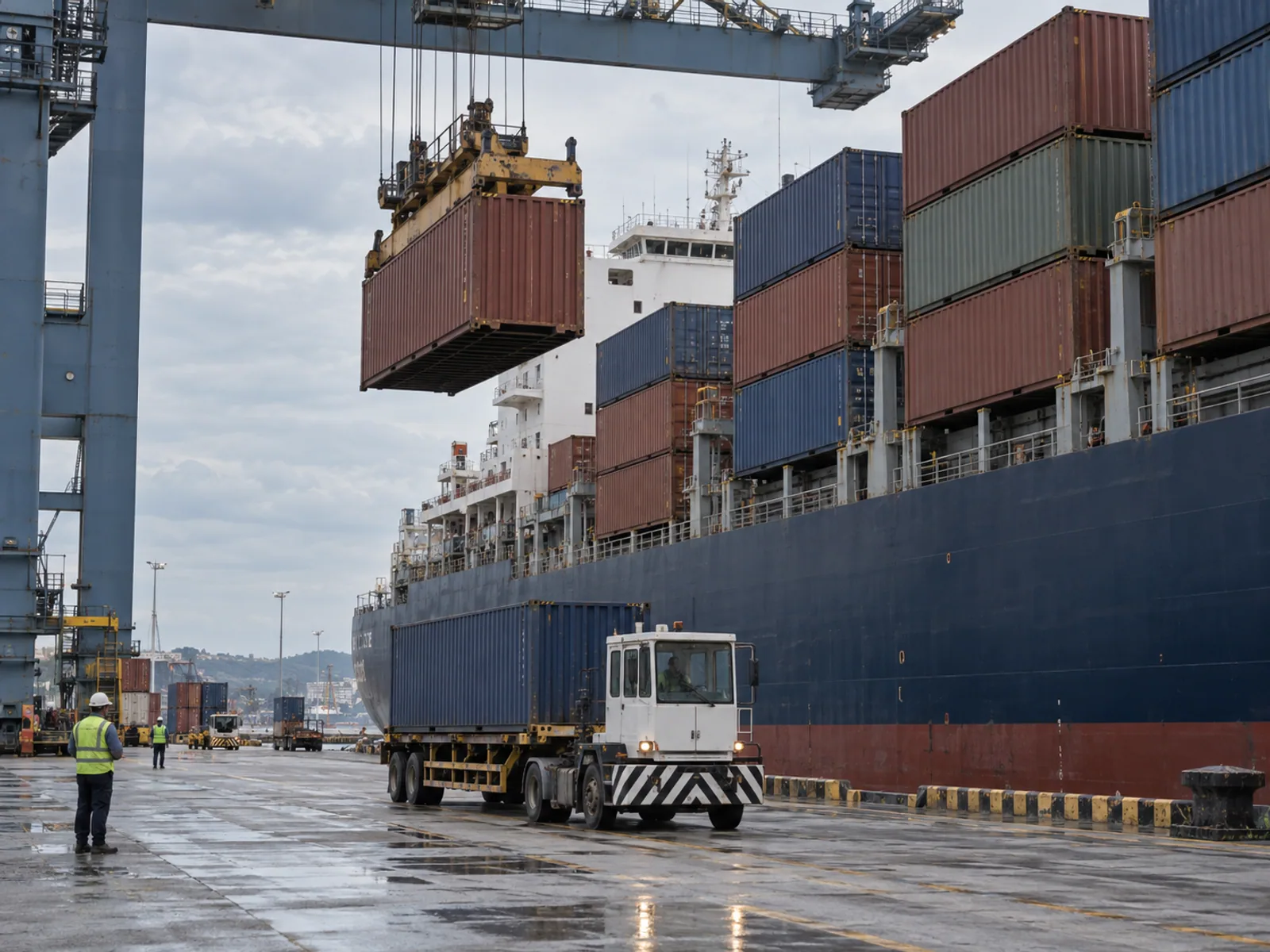
A container is lifted between a vessel and a working terminal.

You buy space in a container instead of the whole container

LCL — less than container load — means your cargo shares a container with other shippers' cargo. You pay for the space you use, measured in cubic metres, rather than for a box you have only partly filled.

The container is packed at a container freight station at origin, sails as one unit, and is unpacked at a container freight station at destination, where each consignment is separated and released to its own consignee.

What that buys you:

access to sea freight rates without container-sized volume, regular sailings rather than waiting to accumulate a full load, and a cost per cubic metre that does not punish you for shipping ten pallets instead of thirty.

What it costs you:

LCL moves through two extra handling points that FCL does not — consolidation at origin and deconsolidation at destination — so door-to-door transit is longer than the sailing time alone, and your cargo is handled more. Both are manageable. Neither is a surprise if someone tells you about them first.

And when it is not

LCL suits you when:

  • Your volume is below roughly half a container and there is no near-term reason it will not be
  • You ship regularly and want a predictable cost per unit rather than a lumpy one
  • You are testing a market or a product line and do not want to commit to container volumes to find out whether it sells
  • Your goods are not urgent enough to justify air freight but too regular to sit waiting for a full load

FCL is usually better when:

  • Your volume approaches a full container
  • Your cargo is fragile, high-value, or you do not want it handled at a shared facility
  • Your delivery window is tight enough that the deconsolidation step matters

Where LCL stops being cheaper than FCL, and how to work it out yourself

This is the question every importer eventually asks and almost nobody in this market answers, because the honest answer is a calculation rather than a number. Here is both.

12–18 CBM Where the crossover usually falls.

Four steps, using quotes you already have:

  1. Take your LCL quote and add up every line, not just the ocean freight. Origin charges, destination charges, documentation, handling, delivery. That is your real cost. (Section 5 lists what those lines usually are.)
  2. Divide it by your actual cubic metres. That is your true LCL cost per CBM.
  3. Get an all-in 20-foot FCL quote on the same lane, on the same terms including destination charges and delivery.
  4. Divide the FCL total by the same cubic metres. Whichever figure is lower wins for that shipment.

Where the crossover usually falls. A 20-foot container holds roughly 28 cubic metres of usable space, but FCL becomes cheaper well before the box is full — in our experience, commonly somewhere between 12 and 18 CBM. That is a planning guide, not a quote, and four things move it:

Lane and season.

Container rates move far more than LCL rates do. Where FCL rates have fallen, the crossover comes down; when space tightens, it goes up.

Cargo density.

LCL is charged on volume or weight, whichever is greater. Heavy, compact cargo hits the crossover earlier than light, bulky cargo — sometimes much earlier.

What is inside each quote.

An FCL rate that excludes destination charges and haulage is not comparable to an LCL rate that includes them. This is the most common way importers get the comparison wrong.

Free time at destination.

FCL comes with demurrage and detention clocks that LCL does not. If your clearance is slow, an FCL saving can disappear into detention charges.

And the arithmetic is not the whole answer. Crossing to FCL also removes two handling points and the deconsolidation wait. If your cargo is fragile or your delivery window is tight, FCL can be worth choosing slightly before it is cheaper.

Send us the volume and the lane and we will price both, side by side, on the same terms.

Two things to check before you plan around LCL

Consolidation warehouses have physical limits — the heaviest single piece their equipment can lift, and the hazard tier they are licensed to accept. Those limits differ between facilities and they change, so they are verified for your shipment at booking rather than published as a rule.

Two things to tell us early:

  • The weight of your heaviest single package.

    Total consignment weight is rarely the constraint — individual piece weight is, because of the lifting equipment at the consolidation warehouse. Twenty 500 kg pieces is a different problem from one 3.5-tonne machine, and only the second one is a problem.

  • Whether anything in the consignment is hazardous

    — with the UN number and packing group. Consolidation warehouses accept only the lower hazard tiers, and the tier varies by facility.

Above either limit, the answer is usually a full container or a different routing. We confirm both against the specific facility before you book, not when the cargo reaches the warehouse.

Export LCL out of Malaysia

  1. Booking and space.

    You send the commercial invoice and packing list. We check rates and vessel availability through one of the world's leading sea freight consolidators — the relationship that gives a Malaysian SME access to regular consolidations on lanes that would otherwise need container volume to reach — and come back with the booking details for you to confirm.

  2. Collection.

    From your premises, quoted with the shipment. Or deliver into the CFS yourself if that suits you better.

  3. Draft bill of lading, for your confirmation.

    You see the shipping note or draft BL and confirm it before anything is committed.

  4. Draft K1, also for your confirmation.

    The K1 is the Malaysian customs export declaration. The draft is prepared from the BL, invoice and packing list, then comes back to you to approve before it is filed. Nothing is declared in your name that you have not seen. Where your buyer needs a certificate of origin to claim a preferential rate at their end, that is identified and arranged here too.

  5. Into the CFS, and onboard.

    Confirmed BL and K1 go to the CFS team, your cargo is consolidated, and it sails on the scheduled consolidation.

  6. At destination.

    Deconsolidation and release to your consignee. On programmes where we handle the far end, we clear and deliver onward.

Import LCL into Malaysia

At origin. Collection from your supplier's factory or warehouse, consolidation, and departure. On the China lane, our own representatives and agents handle the origin end.

Documents checked before the cargo moves. Including the certificate of origin, which we verify against the shipment — description, quantities, values — because a mismatch voids the preferential rate on the whole consignment and cannot be fixed after arrival.

Arrival at Port Klang. North Port or West Port. Deconsolidation, import declaration, duty, tax and SST settled, release.

Delivery onward. To your warehouse, your distribution centre, or your customer's — including retail distribution nationwide where that is the programme.

Malaysia's trading markets, in both directions

Inbound to Port Klang, our established origins are China, Hong Kong and Vietnam. On the China lane, our own representatives and agents handle the origin end, which is the part most Malaysian forwarders of our size cannot offer.

Beyond that, we cover Malaysia's principal trading markets in both directions. We work through multiple shipping lines, NVOCCs and consolidators rather than a single carrier relationship, which is what makes that possible without publishing a lane list that goes out of date.

Asia
Singapore, China, Hong Kong, Taiwan, Japan, South Korea, Thailand, Vietnam, Indonesia, the Philippines, India
Americas
the United States, Canada, Mexico
Europe
the Netherlands, Germany, the United Kingdom, France, Italy, Spain
Oceania and the Middle East
Australia, New Zealand, the UAE, Saudi Arabia

If your lane is not on that list, ask anyway. It is a list of where Malaysian trade goes, not a limit on where we book.

How LCL is priced, so you can read a quote properly

LCL is charged on whichever is greater — the volume your cargo occupies or its weight — which is why a light, bulky consignment can cost the same as a heavy, compact one. On top of the ocean freight itself there are origin charges, destination charges, and the documentation and handling that go with consolidation.

A quote that shows only an ocean freight figure is not a landed cost, and comparing two of them tells you very little.

What actually appears on an LCL invoice

Ocean freight is one line of eight or ten. Publishing the rest is unusual, and it is the only way to make two quotes comparable:

What actually appears on an LCL invoice
Origin side —the LCL charge itself, CFS warehouse handling, bill of lading fee, forwarding fee, customs form fee, EDI transmission, VGM (verified gross mass, mandatory under SOLAS), SOLAS admin, EFT, and a fuel adjustment factor.
Destination side —ocean freight where the shipment is sold freight-collect rather than prepaid, then the same pattern again at the far end: CFS, LCL charge, warehouse handling, forwarding, customs form, EDI — plus final delivery.

Not every line applies to every shipment and the labels differ between forwarders, which is exactly why "our ocean freight is cheaper" is not a statement about cost. We quote the lines.

On transit time. Sea transit generally runs 14 to 45 days depending on the lane, and we confirm the schedule per sailing at booking rather than publishing a figure that will not hold. LCL adds consolidation and deconsolidation on either end of that.

Why ADS

  • Consolidator access without consolidator volume.

    We book through one of the world's leading sea freight consolidators, alongside direct relationships with shipping lines and NVOCCs. On our own, no Malaysian company our size gets regular consolidations across that many lanes; through those relationships, an SME shipping four pallets does.

  • We clear at both ends of the lane.

    Malaysian export and import clearance at Port Klang and KLIA, and destination clearance on programmes where we run the far end.

  • Our own representatives in China.

    On the inbound lane that most Malaysian importers depend on, we have people at origin — which is what makes origin document checks and Form E assistance something we deliver rather than chase.

  • Compliance is not a separate conversation.

    Classification, duty position, certificates of origin and any product approval are identified before the cargo moves, by the same people handling the freight.

  • Since 2009.

    Moving cargo into and out of Malaysia.

  • No minimum volume.

    One pallet is a perfectly normal place to start.

FAQ

What does LCL mean?

Less than container load. Your cargo shares a container with other shippers' consignments and you pay for the space you use rather than for the whole box.

Is LCL cheaper than FCL?

Per cubic metre, yes, until your volume gets close to a full container — at which point FCL usually becomes cheaper in total, commonly somewhere between 12 and 18 CBM. Where it actually crosses depends on your lane, your cargo density and what each quote includes. Section 2 sets out how to work it out on quotes you already hold, and we will price both side by side on request.

How long does LCL take?

Sea transit generally runs 14 to 45 days depending on the lane, plus consolidation at origin and deconsolidation at destination. We confirm the schedule for your specific sailing at booking.

Is there a minimum shipment size?

No.

Do you collect from my premises?

Yes. Collection is quoted with the shipment.

Is my cargo safe sharing a container?

It is handled more than FCL cargo, at the consolidation and deconsolidation points, which is the real trade-off. Proper packing for LCL matters more than it does for a full container, and we will tell you if what you are planning is not adequate.

Can you handle customs clearance as well?

Yes, at both ends. We clear in Malaysia and at destination on programmes where we run the far end.

Do you ship LCL into Malaysia as well as out?

Yes. China, Hong Kong and Vietnam are established inbound origins. On the China lane, our own representatives handle the origin end.

What documents do I need?

Commercial invoice, packing list, and the bill of lading. Depending on the product and the lane, also a certificate of origin, and any permit or approval the product requires. We tell you which apply before the cargo moves.

Do you handle dangerous goods on LCL?

Yes, within limits. Consolidation warehouses accept only the lower hazard tiers, and the tier depends on the facility, so this is confirmed case by case at booking. We prepare the documentation and booking, then route the shipment to IMDG-approved carriers who sign the shipper's declaration. Send us the UN number and packing group and we will tell you what is possible on your lane.

Can you arrange marine cargo insurance?

Yes, and it is worth understanding why you need it. A carrier's liability under a bill of lading is limited by international convention and is calculated on weight, not on what your goods are worth — on a light, valuable consignment it can be a small fraction of the value. That is not insurance, and most importers assume it is. Marine cargo insurance covers the value of the goods. We can arrange it with your booking — ask before you ship rather than after.

Can I track the shipment?

Our customer portal — where you create shipments, track them, pull shipping reports and view invoices — currently covers express. Sea freight is tracked against the bill of lading, and we keep you updated against the booking. Tell us how you want milestones sent and we will work to that.

Is there a weight limit on a single package?

Yes, and it is the individual piece that matters rather than the total consignment — the constraint is the lifting equipment at the consolidation warehouse. The limit varies by facility, so tell us the weight of your heaviest single package with the booking enquiry and we will confirm it against the warehouse handling your shipment. An oversized single piece usually points to a full container instead.

Tell us the volume and the lane, and we will tell you which mode is cheapest

Send us the dimensions, the weight, where it is going and how often. We will come back with LCL and FCL priced side by side, the realistic transit, and what the cargo needs in documentation at the far end.

Talk to a logistics specialist